High-Protein Baked Oatmeal
A completely different texture from the overnight oats already on this site — that one is cold and pudding-like, this bakes into something closer to a cross between a cake and a bowl of oatmeal, sliceable into squares and good eaten cold straight from the fridge, not just warmed up. The appeal is really about the format: instead of five minutes of prep every single night, you spend about ten minutes assembling a batch once, let the oven do the rest, and end up with a full week of breakfast already portioned into squares. No jars to wash daily, no deciding what to eat at 7am — just open the fridge and grab one.
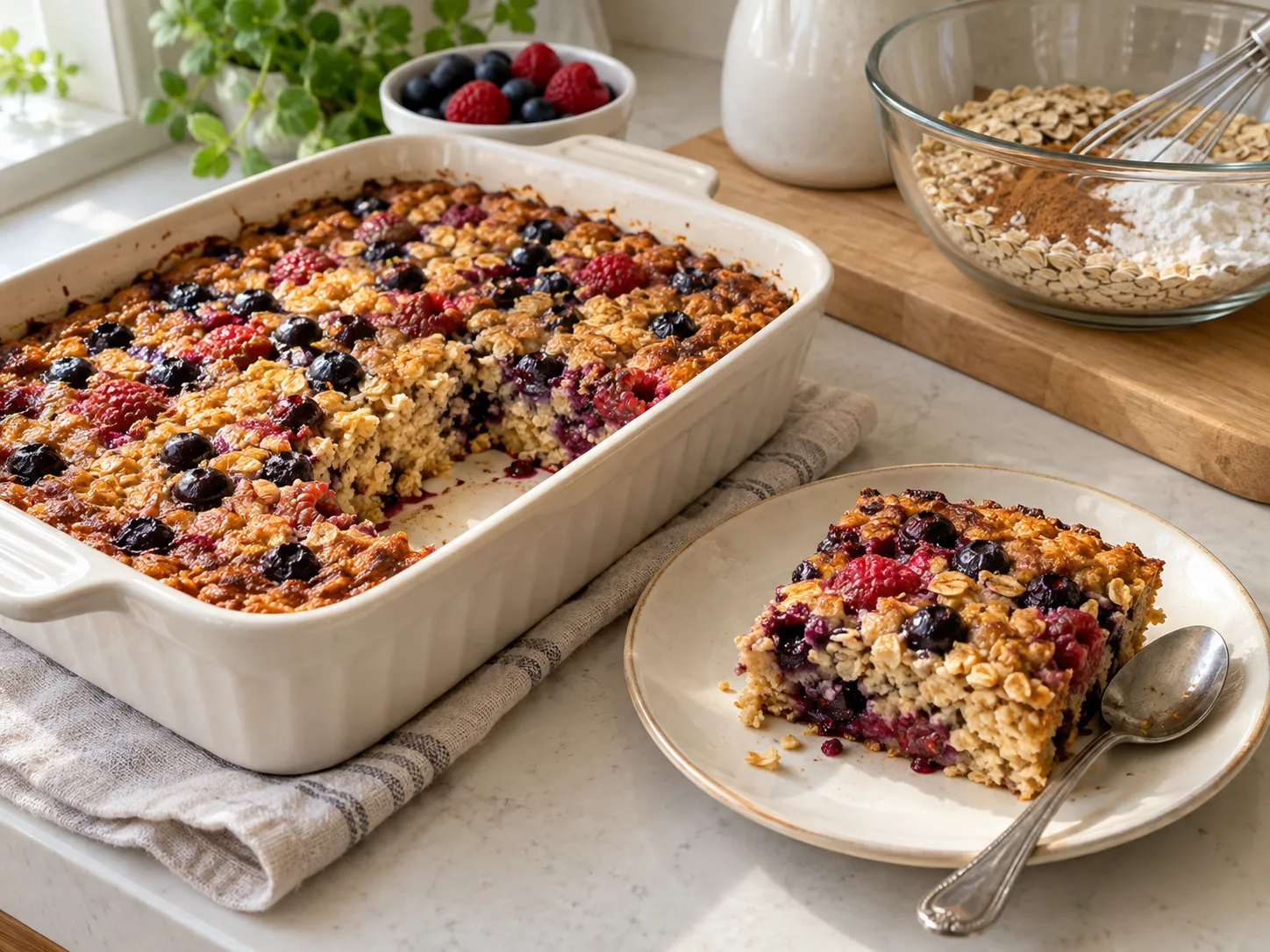
Most baked oatmeal recipes lean on oats and fruit alone, which makes for a pleasant but fairly low-protein breakfast — closer to 5–6g a serving. This version folds in eggs and dry milk powder specifically to change that math, landing closer to 15g a serving without changing the texture or flavour people actually expect from baked oatmeal.
| Estimated cost per serving | Cheap |
| Protein per serving | ~14–17g* |
| Prep time | 10 minutes |
| Cook time | 35 minutes |
| Servings | 6 |
| Freezer-friendly | Yes |
*Protein is an estimate. Actual values depend on your exact ingredients and portions.
Ingredients

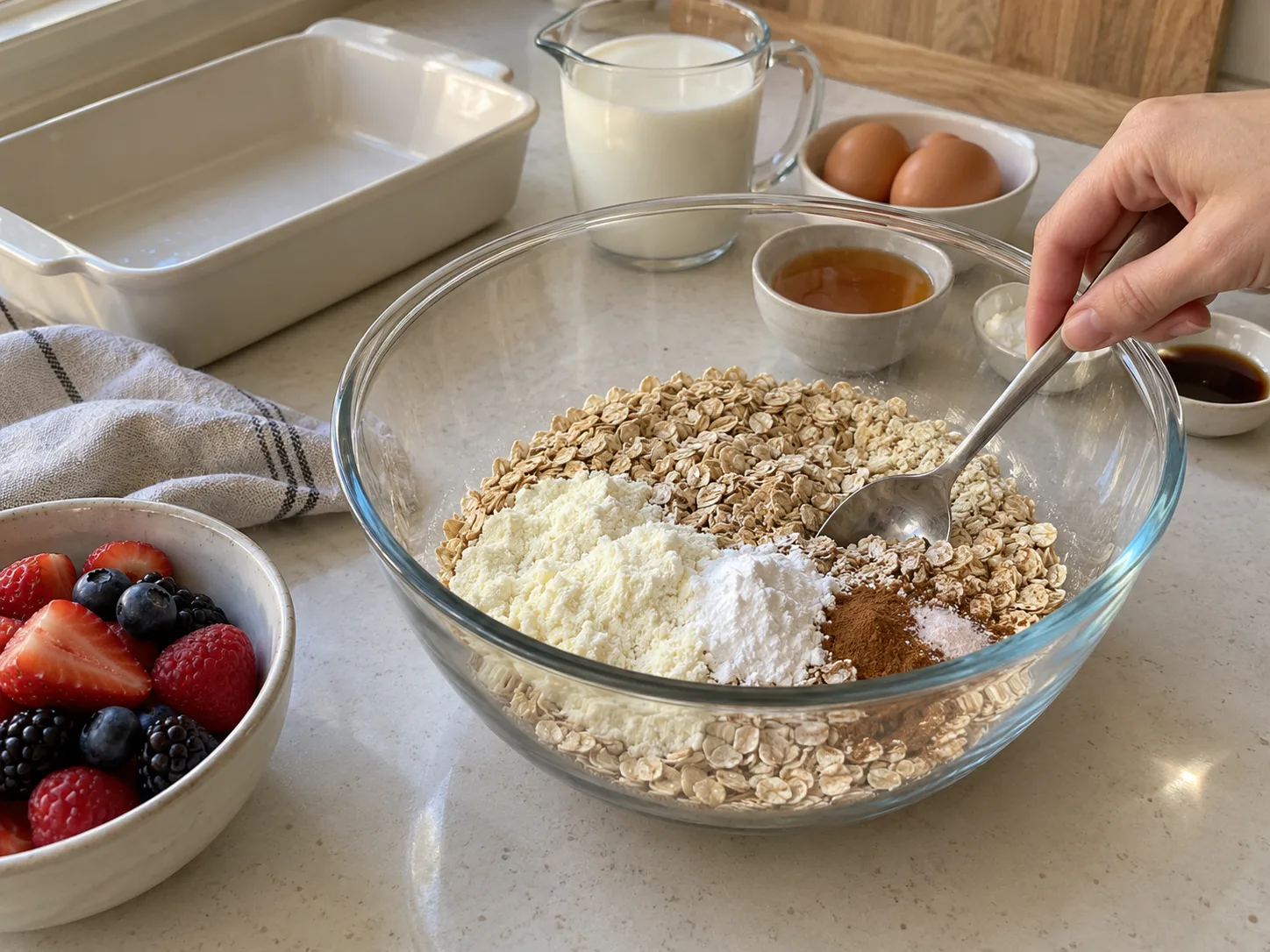
- 2 cups rolled oats
- 1/4 cup non-fat dry milk powder
- 1 tsp baking powder
- 1 tsp cinnamon
- 1/2 tsp salt
- 2 eggs
- 1.5 cups milk
- 1/3 cup honey or maple syrup
- 1 tsp vanilla extract
- 1 cup mixed berries, fresh or frozen
How to make it

- Preheat the oven to 375°F / 190°C. Grease an 8×8-inch baking dish.
- In a large bowl, combine the oats, dry milk powder, baking powder, cinnamon, and salt.
- In a separate bowl, whisk the eggs, milk, honey, and vanilla together.
- Pour the wet ingredients into the dry ingredients and stir to combine. Fold in the berries, saving a few to scatter on top.
- Pour into the baking dish, top with the reserved berries, and bake 30–35 minutes, until set, golden on top, and 165°F / 74°C in the centre. Let cool 10 minutes before cutting into squares.

Baked oatmeal cups
Grease a 12-cup muffin tin and divide the batter evenly. Bake at 350°F / 175°C for 18–22 minutes, until the centres reach 165°F / 74°C. Rest 5 minutes before removing. The cups cool and freeze faster than squares, making them the most convenient grab-and-go format.

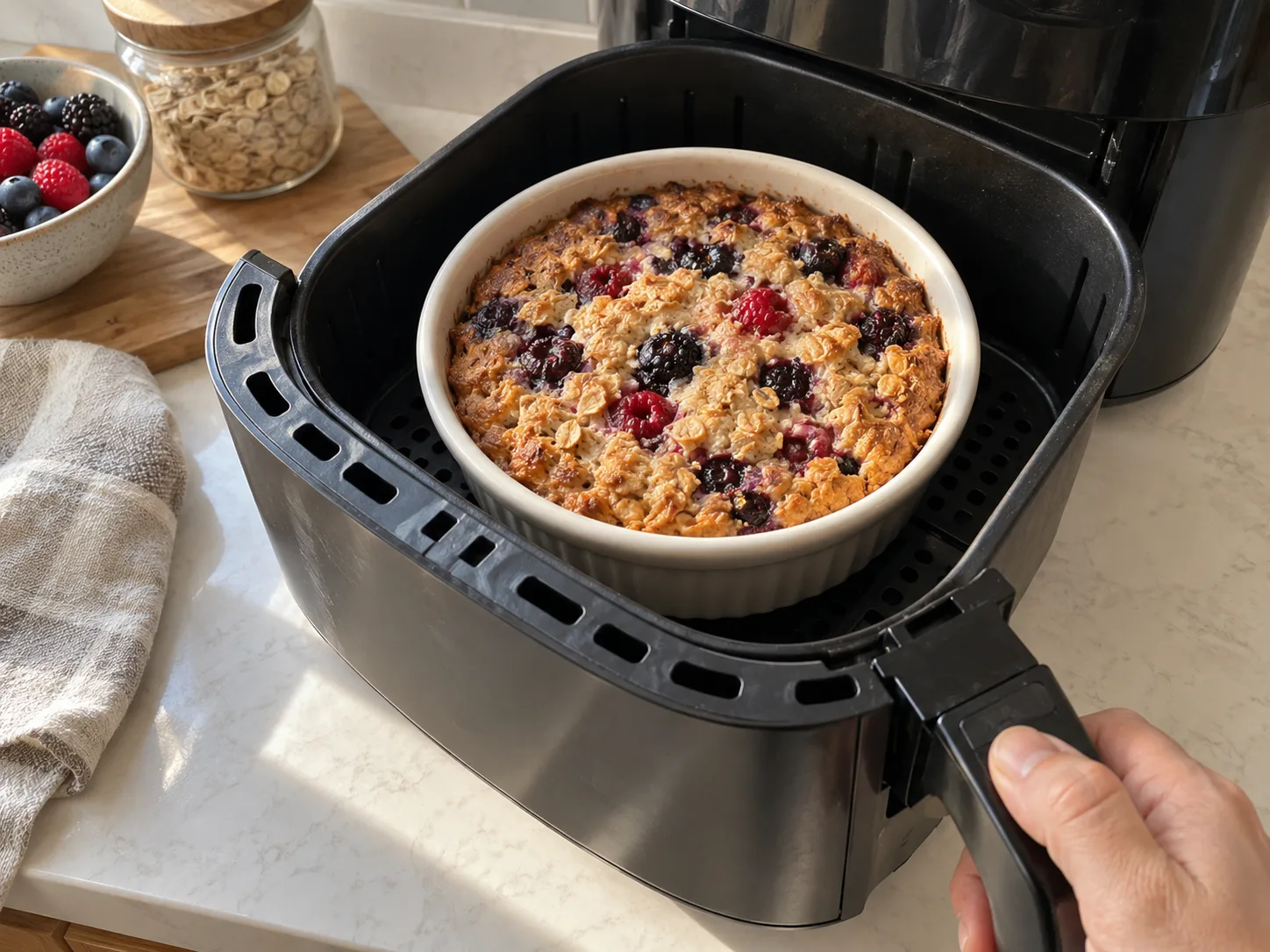
Air fryer half-batch
Make half the recipe in a greased 6-inch / 15cm round pan that fits your basket. Air fry at 320°F / 160°C for 22–28 minutes, until the centre is set and reaches 165°F / 74°C. Rest 10 minutes before slicing.
Which method is best?
- Best overall: 8×8-inch oven bake. It gives the most even, cake-like squares with minimal handling.
- Best for freezer portions: muffin tin. The cups are ready to bag individually and thaw quickly.
- Best small batch: air fryer. It makes three servings without heating the full oven.
Cost and protein breakdown
- Oats, milk, dry milk powder, eggs — all inexpensive, and together the main protein base
- Berries — cheaper frozen than fresh, especially bought in a large bag
- Total estimate — cheap to make, per serving
Protein lands around 14–17g per serving, noticeably higher than a typical baked oatmeal thanks to the eggs and dry milk powder doing real work here rather than just oats and fruit.
Rolled oats vs. steel-cut vs. instant — why rolled is specified here
These aren’t interchangeable in this recipe the way they sometimes are in a stovetop porridge. Steel-cut oats are chopped rather than flattened, and they need far more liquid and a much longer cook time to soften — used here, they’d stay noticeably chewy and undercooked in the 30–35 minute bake window this recipe is built around. Instant oats are pre-cooked and dried, so they turn almost mushy and lose all texture when baked, closer to a gluey paste than a sliceable square. Rolled oats sit in the middle: fully flattened and quick-cooking, but with enough structure left to hold their shape and give the finished dish some chew. If rolled oats aren’t available and a swap is unavoidable, quick oats (a slightly thinner cut of rolled oats, not the same as instant) are the closest substitute, though the texture comes out a touch softer.
Why eggs and baking powder are doing more than you’d think
Oats alone, even soaked in milk, won’t hold together into a slice — they’ll just fall apart into porridge the moment a fork touches them. The eggs are the real structural ingredient here: they set like a loose custard as the dish bakes, binding the oats into something firm enough to cut. The baking powder adds a small amount of lift, keeping the texture from baking into a dense brick. Skip either one and you end up with something closer to a wet, baked porridge than a sliceable square — still edible, just not what this recipe is going for.
How this compares to a granola bar or muffin for the same purpose
A standard store-bought granola bar or breakfast muffin usually carries somewhere in the 3–5g protein range and a fair amount of added sugar, mostly from refined carbohydrate rather than anything that keeps you full. A square of this baked oatmeal carries three to four times that protein, with the sugar coming from honey or maple syrup you control the amount of rather than a packaged product’s formulation. It’s also meaningfully cheaper per serving than almost any packaged grab-and-go breakfast item, since you’re paying for oats, eggs, and milk rather than packaging and a brand name.
Flavour variations
- Pumpkin spice: replace 1/2 cup of the milk with canned pumpkin puree, swap the cinnamon for 1.5 tsp pumpkin pie spice, and drop the berries. Good in the fall and freezes just as well.
- Chocolate peanut butter: add 2 tbsp cocoa powder to the dry ingredients and swirl 3 tbsp peanut butter over the top before baking. Drop the berries for this one — the flavours don’t need them.
- Apple cinnamon: swap the berries for 1.5 cups diced apple and bump the cinnamon to 1.5 tsp. The apple softens fully during baking, so no need to pre-cook it.
- Banana walnut: swap the berries for 2 mashed ripe bananas folded into the wet ingredients, plus 1/3 cup chopped walnuts scattered on top. The banana adds natural sweetness, so you can cut the honey down to 2 tbsp.
Scaling the recipe up or down
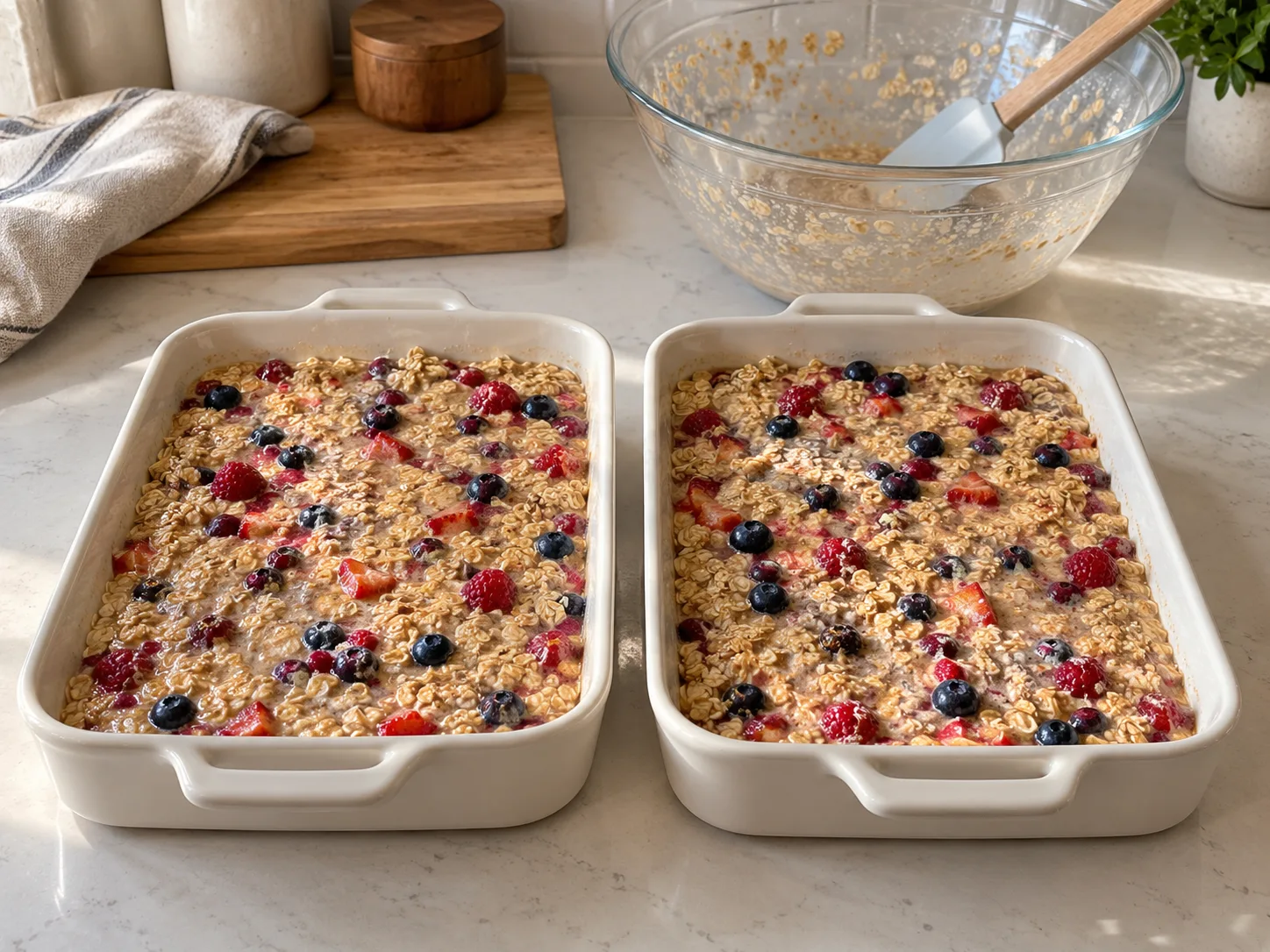
For 12 servings, double every ingredient and use a 9×13-inch dish. Bake at the same temperature, start checking at 35 minutes, and continue until the centre reaches 165°F / 74°C. For a half batch, use a loaf pan or 6-inch dish and start checking around 20 minutes. Pan depth matters more than the total amount, so use the centre temperature rather than adding a fixed number of minutes.
Common mistakes
- Not greasing the dish well enough. This bakes up more like a custard-bound cake than a dry granola bar, and it will stick to an under-greased pan. A thorough coat of butter or oil on the bottom and sides saves a frustrating cleanup.
- Using very ripe, watery berries straight from frozen without draining. Frozen berries release a surprising amount of liquid as they thaw in the oven, which can leave a soggy ring around each berry. Tossing the frozen berries in a teaspoon of the dry oat mixture before folding them in helps absorb some of that extra moisture.
- Cutting into it immediately. Like most egg-bound bakes, this firms up further as it cools. Cutting it hot gives you a square that falls apart on the plate; waiting the full 10 minutes gives you a clean slice.
What to top it with
A spoonful of Greek yogurt on top adds even more protein and a cool contrast to the warm oats if eating it fresh from the oven. A drizzle of peanut butter, thinned slightly with a splash of milk so it actually drizzles instead of clumping, works well on the fruit-based versions. For the cold-from-the-fridge version, a splash of cold milk poured over the square right before eating softens the edges slightly and makes it eat closer to a bowl of cereal.

How to make it cheaper
- Buy oats in bulk. A large bag brings the per-serving cost down meaningfully.
- Use frozen berries rather than fresh, especially outside of berry season.
- Skip the dry milk powder if you don’t have it — the dish still works, just with a bit less protein.
Baked oatmeal vs. overnight oats: which one actually fits your week
Both solve the same problem — a protein-boosted oat breakfast ready before you’re fully awake — but they fit different routines. Overnight oats need almost no active time (five minutes of stirring the night before) but only make one portion at a time, since each jar is mixed individually. Baked oatmeal takes longer up front (about 45 minutes, mostly hands-off while it bakes) but makes a full week’s worth in one go, and it’s the better choice if mornings are too rushed to even open a jar and stir in toppings. If you’ve got 45 minutes on a Sunday, this is the lower-effort option across the whole week; if you’d rather do five minutes every single night, overnight oats wins.
Equipment notes
A glass or ceramic 8×8-inch baking dish is the standard size for this amount of batter and gives squares about an inch thick, which holds together well when lifted. A metal pan works too and may bake slightly faster at the edges — start checking for doneness a few minutes early if using one. Glass retains heat longer after coming out of the oven, so the squares keep cooking a little further on the counter; factor that into when you pull it, especially if you tend to like the centre slightly underdone rather than fully set.
Storage and freezing
- Fridge: cool, cut, and refrigerate within 2 hours; use within 3–4 days.
- Freezer: freeze squares or cups in a single layer, then transfer to a labelled bag for up to 2 months.
- Microwave: cover and heat 30–45 seconds from the fridge. From frozen, use 50–70% power for 60 seconds, then continue in 20-second intervals.
- Air fryer: reheat at 300°F / 150°C for 4–6 minutes from the fridge or 8–10 minutes from frozen.

Where to find dry milk powder if you’ve never bought it
It’s usually shelved with the shelf-stable milk or in the baking aisle near evaporated and condensed milk, not in the refrigerated dairy section — that’s the most common reason people can’t find it on a first trip. A single box lasts a long time, since recipes on this site only call for a few tablespoons at a time, and it keeps for well over a year unopened in the pantry. If your store genuinely doesn’t carry it, a well-stocked bulk food store almost always will, often cheaper by weight than the boxed version.
Frequently asked questions
Can I use quick oats instead of rolled?
Yes, though the texture comes out a bit softer and less distinctly textured. Rolled oats hold their shape better through baking, which gives a chewier, more defined result.
My baked oatmeal came out dry — what happened?
Usually overbaked. Pull it as soon as the centre looks set and no longer wet — a few extra minutes in the oven dries it out more than you’d expect, since oats continue absorbing moisture even after baking stops.
Can I add banana or other fruit instead of berries?
Yes — sliced banana, diced apple, or chopped peaches all work well as a direct swap for the berries, folded in the same way.
Can I use a dairy-free milk?
Yes — unsweetened soy or oat milk both work as a direct swap. Soy milk is the better choice protein-wise, since it’s the closest plant milk to dairy milk in protein content; almond and rice milk are both quite low in protein and will lower the total a bit. Leave out the dry milk powder if going dairy-free, since that ingredient is specifically a milk product, and consider an extra egg in its place for some of the protein back.
Is this good for meal prepping a whole week of breakfasts?
Yes, and it’s one of the more convenient options on the site for exactly that — one batch makes 6 squares, it holds for 4–5 days in the fridge without reheating being necessary, and there’s zero morning prep beyond cutting a square and grabbing a fork. Doubling the batch into a 9×13 dish extends that to closer to 12 servings, enough to cover two weeks if you freeze half.
Related reading: High-Protein Overnight Oats, Budget High-Protein Smoothie, and Cheap High-Protein Breakfasts.