High-Protein Crustless Quiche
Skipping the crust does two things: cuts the cost and the carbs, and turns a fussy, roll-your-own-pastry recipe into something you can mix and pour in ten minutes. This bakes up more custardy and substantial than the egg muffins already on this site — a real sliced dish for brunch or dinner, not a grab-and-go bite.

It’s also a good option for anyone who’s wanted to make quiche but has been put off by pastry work in the past — rolling and blind-baking a crust is genuinely one of the more finicky steps in home baking, and skipping it entirely removes the single biggest barrier to making this dish on a random weeknight rather than saving it for a special occasion.
| Estimated cost per serving | Cheap |
| Protein per serving | ~16–20g* |
| Prep time | 10 minutes |
| Cook time | 35 minutes |
| Servings | 6 |
| Freezer-friendly | Yes |
*Protein is an estimate. Actual values depend on your exact ingredients and portions.
The custard ratio, and why it’s worth knowing
This recipe works out to roughly 1 egg per 2 tablespoons of milk, which is a fairly rich, firm-setting custard ratio — more milk relative to eggs gives a softer, more delicate set, while less milk gives a denser, more frittata-like result. Knowing this ratio matters if you want to adjust the quantities for a different dish size: an 8-egg custard fills a standard 9-inch pie dish well, but if you’re using a larger or smaller dish, scale the eggs and milk together in that same rough proportion rather than just eyeballing it, or the quiche will either overflow or come out too shallow and overcooked.

Ingredients

- 8 large eggs
- 1 cup milk
- 1 cup diced vegetables (spinach, bell pepper, onion, mushrooms)
- 1/2 cup diced cooked ham or turkey bacon, optional
- 1 cup shredded cheese
- 1/4 cup flour
- 1/2 tsp baking powder
- Salt and pepper to taste
How to make it

- Preheat the oven to 375°F / 190°C. Grease a 9-inch pie dish or deep baking dish.
- Whisk the eggs and milk together until well combined. Whisk in the flour and baking powder — this small amount of flour is what gives a crustless quiche enough structure to hold together without a pastry shell.
- Stir in the vegetables, meat if using, and most of the cheese (save a small handful for the top), along with salt and pepper.
- Pour into the prepared dish and sprinkle the reserved cheese on top.
- Bake 30–35 minutes, until the top is golden, the centre has only a slight jiggle, and a thermometer in the middle reads 165°F / 74°C. Let rest 10 minutes before slicing.

Air fryer method for a half batch
Most air-fryer baskets will not hold a 9-inch pie dish, so halve every ingredient and use a greased 6-inch / 15cm round pan that fits with space for air to circulate. Pre-cook watery vegetables as in the main recipe. Preheat to 320°F / 160°C, place the filled pan in the basket, and cook for 20–25 minutes. Start checking at 20 minutes; the centre should have only a slight jiggle and reach 165°F / 74°C. Rest 10 minutes before slicing.

Which method is best?
- Best for six servings or two flavours: Oven — the full recipe fits a standard pie dish and two dishes can bake together.
- Best small batch: Air fryer — half the recipe, less preheating, and four smaller portions.
- Best reheating texture: Oven or air fryer at 300°F / 150°C; the microwave is faster but makes the custard softer.
A slow cooker or pressure cooker is not recommended here: both trap moisture and prevent the lightly browned top that makes the baked version work.
Cost and protein breakdown
- 8 eggs and 1 cup milk — the main protein base, inexpensive relative to what it serves
- Vegetables, cheese, optional meat — flexible, use whatever’s on hand or cheapest
- Total estimate — cheap to make, per serving
Protein lands around 16–20g per serving, from the eggs, milk, and cheese combined. Adding the optional ham or turkey bacon pushes individual servings a few grams higher still, and is a reasonable addition specifically on days this is serving as a full meal rather than a lighter brunch side.
Why a little flour, with no crust
A traditional quiche relies partly on the crust to hold its shape when sliced. Without one, a straight egg-and-milk custard can be a bit too soft to cut cleanly. A quarter cup of flour whisked in gives just enough structure to slice neatly while still baking up tender, not bready — it’s a small amount, not enough to notice as a separate flavour or texture.
Flavour variations
The base recipe is deliberately open-ended, and a few combinations consistently work well. For a quiche Lorraine-style version, use bacon or ham with Swiss or gruyère cheese and a bit of sautéed onion, skipping the other vegetables. For a Mediterranean version, use spinach, crumbled feta instead of shredded cheese, and a few chopped sun-dried tomatoes. For a Southwest version, use bell pepper, black beans, a pinch of cumin, and pepper jack cheese. Because the egg-milk-flour base stays the same across all of them, you can treat this recipe as a template and swap the cup of vegetables, the optional meat, and the cheese freely without touching the method at all.
Scaling it up for a brunch crowd
For a bigger gathering, two quiches in two separate pie dishes work better than trying to double everything into one oversized dish — a single dish that’s too deep tends to cook unevenly, setting around the edges while the centre stays underdone. If you want variety rather than two identical quiches, this is also an easy way to offer two different flavour combinations from the list above at the same brunch without doubling the work, since both bake at the same temperature and roughly the same time.

Common mistakes
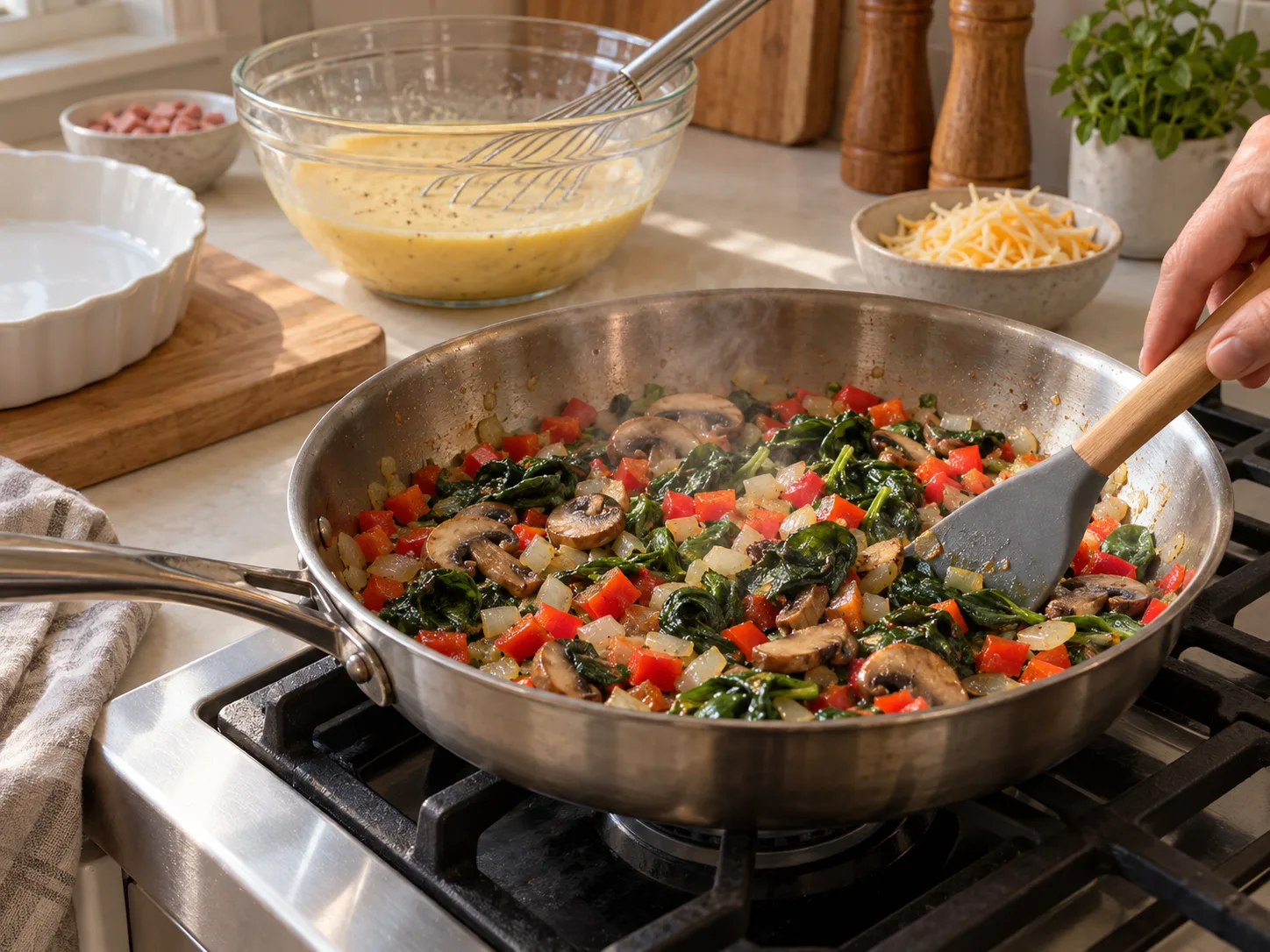
Not pre-cooking watery vegetables. As the FAQ below explains, this is the single most common cause of a soggy-bottomed quiche. Spinach, mushrooms, and tomatoes all need a few minutes in a dry pan first.
Overbaking in pursuit of a completely firm centre. A quiche continues to set during the rest period after baking, the same way a cheesecake does. Pulling it from the oven while the centre still has a slight jiggle, rather than waiting for zero movement at all, avoids a dry, overcooked result once it’s fully rested.
Using a dish that’s too shallow for the volume of custard. A shallow dish risks overflowing as the eggs puff slightly in the oven. A standard 9-inch pie dish or a deep-dish pie plate is the right depth for this quantity; a thin tart pan is not.
How to make it cheaper
- Skip the meat — the vegetables and cheese already make a flavourful, filling quiche.
- Use frozen vegetables instead of fresh — thaw and squeeze out excess water first so the quiche doesn’t turn watery.
- Buy a cheese block instead of pre-shredded, as with most recipes on this site.
- Use up vegetable scraps and leftovers. A quiche is a genuinely good destination for small amounts of leftover cooked vegetables from earlier in the week, rather than buying a fresh cup specifically for this recipe each time.
Storage and freezing
- Fridge: Cool, cover, and refrigerate within 2 hours. Keep slices for 3–4 days at 40°F / 4°C or below.
- Freezer: Wrap fully cooled slices individually and freeze for up to 2 months. Thaw overnight in the refrigerator for the most even reheating.
- Reheating: Microwave a slice at 70% power in 30-second intervals, or cover and warm at 325°F / 160°C for 8–12 minutes, until the centre reaches 165°F / 74°C.
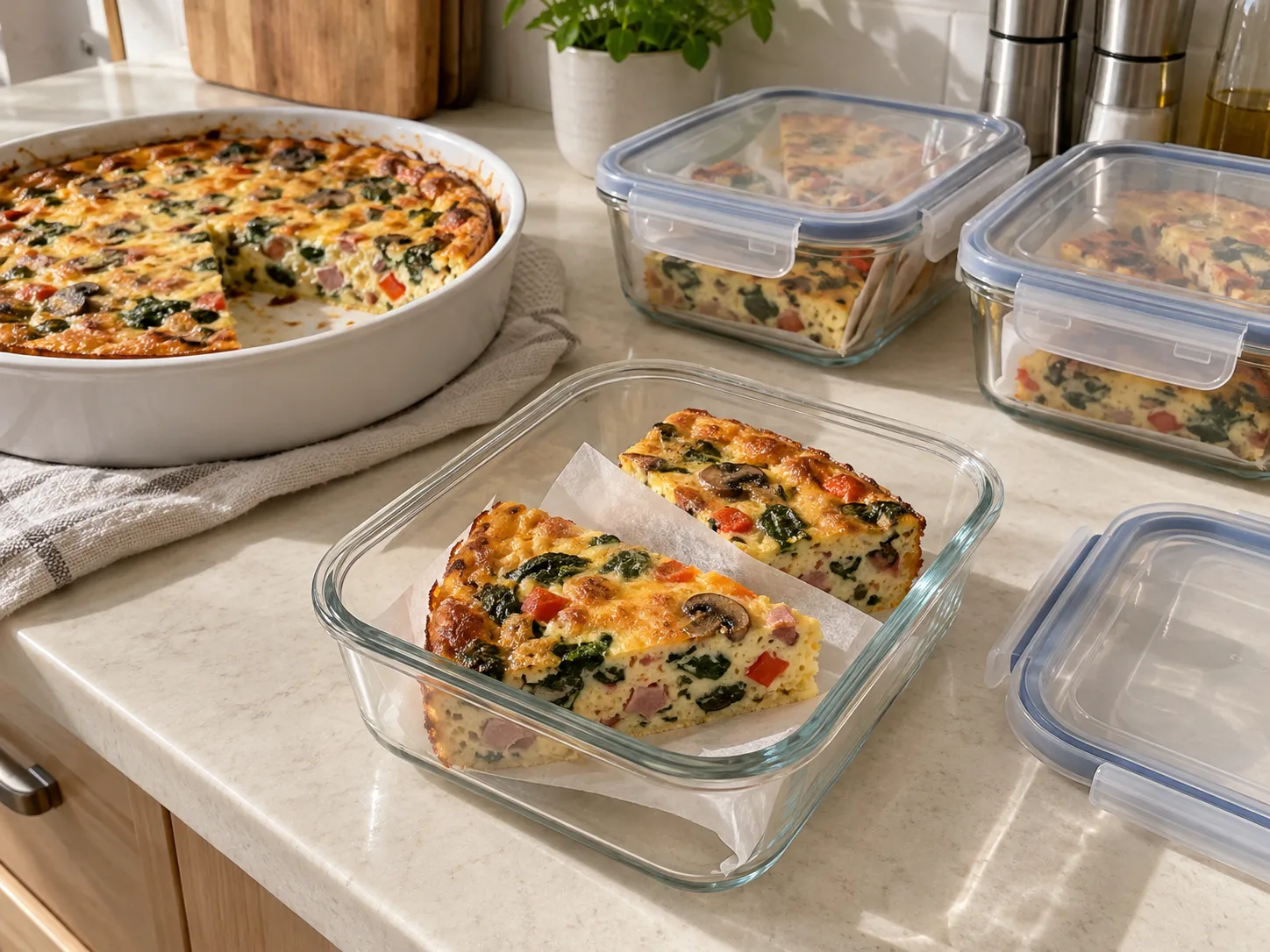
Letting the whole quiche cool completely to room temperature before slicing and wrapping individual portions makes a real difference to how cleanly it holds together in storage — slicing it warm, even after the recommended 10-minute rest, is more likely to produce ragged edges than slicing it once it’s fully cooled. If you’re prepping for the week, baking it the night before and slicing cold the next morning gives the cleanest results.
Frequently asked questions
My quiche came out watery at the bottom — why?
Almost always from vegetables that released water during baking — fresh spinach, mushrooms, and tomatoes are the usual culprits. Cook these down in a dry pan for a few minutes first to release and evaporate most of their moisture before adding them to the egg mixture.
Mushrooms in particular release far more water than their size suggests — a cup of raw sliced mushrooms can lose nearly half its volume in released liquid once sautéed, which is exactly why skipping that step and adding them raw causes problems. Give watery vegetables a full 5–7 minutes in a dry or lightly oiled pan over medium heat, until you can visibly see them stop releasing liquid, before folding them into the egg mixture.
How do I know when it’s actually done?
Give the dish a gentle shake — the centre should jiggle only slightly, like set gelatin, not move like liquid. A knife inserted near the centre should come out clean. It will continue to firm up a bit more during the 10-minute rest after baking.
An instant-read thermometer is the clearest check if the jiggle test feels subjective: the centre should reach 165°F / 74°C. Insert the probe into the middle without touching the bottom of the dish.

Can I make this ahead for a brunch?
Yes — bake it the day before, refrigerate, and reheat whole in a 325°F / 160°C oven for about 20 minutes, or serve at room temperature, which is traditional for quiche and fine food-safety-wise as long as it was properly refrigerated beforehand and isn’t left out for more than 2 hours.
What should I serve alongside it for a full brunch?
A simple green salad with a light vinaigrette balances the richness of the custard well, and fresh fruit is a classic, low-effort pairing that doesn’t compete with the quiche’s flavour. If you want something more substantial alongside it, roasted potatoes or a simple hash fill out the plate without duplicating the egg-based protein already in the quiche itself.
Can I use just egg whites instead of whole eggs?
Yes, though expect a lighter-coloured, slightly less rich result — substitute roughly 1.5 cups liquid egg whites for the 8 whole eggs. The flour-and-baking-powder structure still works the same way, so it should still slice cleanly, just with less of the golden colour whole eggs give the top.
Why add baking powder to a quiche?
It’s a small addition that gives the custard a slight lift as it bakes, resulting in a marginally fluffier texture than a completely flat egg custard would have — closer to a baked frittata in lightness, while still holding together cleanly when sliced thanks to the flour. It’s optional in the sense that the quiche will still set without it, but the texture difference is noticeable enough that it’s worth keeping in.
Related reading: High-Protein Egg Muffins, Egg White Breakfast Scramble Bowls, and Egg and Potato Breakfast Meal Prep.